Markup and margin on parts
Most shops buy parts at a trade discount and sell them at or near list price, or add a percentage on top of cost. Either way, be clear which number you're talking about. Markup is profit as a share of what the part cost you. Margin is profit as a share of what you sell it for. The same pound of profit is always a bigger markup than margin.
| Markup on cost | Margin on price |
|---|---|
| 20% | 16.7% |
| 25% | 20% |
| 33.3% | 25% |
| 50% | 33.3% |
| 100% | 50% |
Margin = markup ÷ (1 + markup). To hit a target margin, divide cost by (1 − margin): for a 25% margin, a £100 part sells at £133.33.
Remember what the parts line has to cover: ordering, chasing, checking, storing and returning parts all take someone's time, and a wrong part costs a day.
Parts and paint on insurance work
On insurance work you usually don't set the parts and paint price yourself. The CMA's 2014 investigation found that insurers' agreements with network repairers set the labour rate and the discounts for parts and paint off the price the estimating system generates. Insurers may also dictate which parts, paint and estimating systems their repairers use, often because they've negotiated rebates with those suppliers.
The CMA found that 7 of the 10 largest insurers took referral fees from paint or parts suppliers, and that paint list prices rose about three times as fast as prices generally from 2006. Read the parts and paint terms in any network agreement as closely as the labour rate. Our guide to becoming an approved repairer covers the rest of those terms.
Genuine, matching quality and green parts
| Type | What it is |
|---|---|
| Genuine (OEM) | Made to the carmaker's specification and carrying its trademark |
| OES | Made by the carmaker's original equipment supplier, often to the same specification |
| Matching quality | Good enough not to harm the carmaker's reputation. The carmaker can bring evidence that a part falls short |
| Green (recycled) | A used part recovered from another vehicle. We found no official UK definition |
The first three definitions come from the CMA's 2023 guidance on motor vehicle agreements.
With a private customer, agree genuine or non-genuine parts before you start, as The Motor Ombudsman's code asks. Parts you supply with a repair must be of satisfactory quality, fit for purpose and as described under the Consumer Rights Act, whichever kind they are.
Insurers use non-genuine and recycled parts more and more. Hastings' policy booklet says its repairer may use non-manufacturer parts “including recycled parts”, esure's allows “equivalent” parts, and Allianz's fleet network fits green parts on non-safety-critical repairs. BS 10125:2022 aligned its replacement parts guidance with the VRA's UK standard for reclaimed parts.
Shops that use green parts
91%
ABP Club survey of 274 repairers, 2025.
Using more green parts
75%
Same survey.
Using more non-OE parts
59%
Same survey.
The block exemption and your right to parts
Competition law decides how far carmakers can keep parts and repair work inside their dealer networks. The current rules are in the Motor Vehicle Agreements Block Exemption (No. 2) Order 2023, SI 2023/586, which applies from 1 June 2023 to the end of 31 May 2029, and the CMA's guidance on it. An agreement loses the exemption if it:
- Stops a carmaker's authorised network selling spare parts to independent repairers.
- Stops parts makers selling parts or tools to repairers, or putting their own logo on parts.
- Restricts independent repairers' access to the repair information, tools or training the carmaker gives its own network.
On warranties, the CMA says terms that require carmaker-branded parts for replacements outside the warranty, or servicing only in the dealer network, may breach competition law. A carmaker can still refuse a warranty claim caused by faulty repair work or a failed third-party part, so fit good parts and keep the paperwork.
Repair information and SERMI
The CMA's guidance says repair information includes fault codes, software and updates for control units, ADAS and EV battery management, parts catalogues, repair procedures, part codes, and activation codes for new parts. Access should come on request, without undue delay, at prices that don't put you off, and at the same time as the dealers get it for new models.
Type approval law backs this up. Under retained Regulation 2018/858, article 61, carmakers must give independent operators unrestricted, standardised access to diagnostic tools and software, repair information and training material, and their fees must be reasonable and proportionate, with hourly to yearly access. Under the Road Vehicles (Approval) Regulations 2020, regulation 13, anyone who loses out when a carmaker breaks those duties can sue.
Security-related information, for work on a car's security system, goes through SERMI. It went live in the UK on 1 April 2026, with Digidentity issuing credentials. It's mandatory in Northern Ireland but voluntary in Great Britain, where the government has said it doesn't currently plan to make it compulsory.
GuideRepair methods, ADAS calibration and repair informationWhy manufacturers' methods matter, ADAS calibration, and how to get the information you need.What parts and paint prices are doing
Paint
+16%
Q3 2022 to Q3 2023, as insurers told the FCA.
Spare parts
+11%
Same period, same source.
Spare parts to consumers
+5.1%
ONS CPI, year to September 2026.
| Year | Vehicle repair | Spare parts | All prices |
|---|---|---|---|
| 2023 | 8.0% | 3.8% | 7.3% |
| 2024 | 7.0% | 4.8% | 2.5% |
| 2025 | 6.3% | 4.1% | 3.4% |
| Year to Sep 2026 | 3.7% | 5.1% | 3.5% |
CPI series D7IP (maintenance and repair) and L7R3 (spare parts and accessories). These are prices consumers pay, not what insurers pay. There's no UK paint price index.
Supply is the other problem. In the ABP Club's 2025 survey, 38% of bodyshops said parts shortages hit at least a fifth of their jobs. The government's Motor Insurance Taskforce reported in December 2025 that car parts imports were still below pre-pandemic levels, and that semiconductor shortages were lengthening repairs.
On paint, PPG announced a global increase of up to 20% across its paints and coatings in April 2026, rolled out customer by customer. Axalta, BASF, AkzoNobel and 3M announced rises in the US in spring 2026; we found no UK notices, so ask your paint supplier directly.
How paint and materials get priced
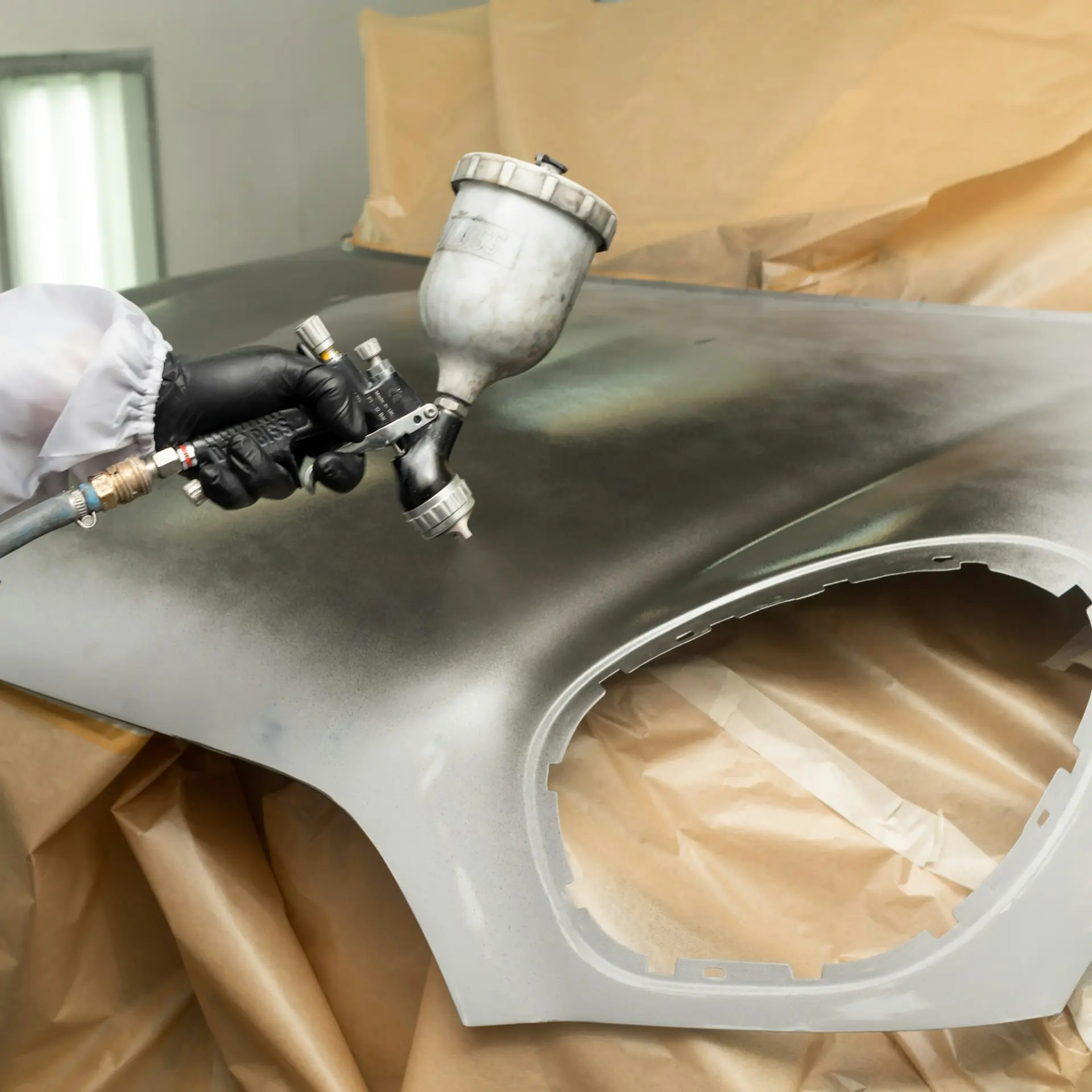
We found no published UK method or rate for paint and materials. On insurance work the estimating system works it out: Audatex's UK paint calculation uses a module from AZT, which takes in material costs, sundries, preparation times and blending times, and the insurer then applies the discount in your agreement. Our guide to Audatex and CAPS covers the system side.
On retail work it's your choice. Common ways to price it include:
- By the panel: a set price for each panel painted, with extra for blending into the next one.
- By the paint hour: a materials rate for every hour of refinish labour on the job.
- From your paint system: the mixing software's cost for the colour and quantity, with a markup and an allowance for sundries.
VAT on car repairs and VAT invoices
Car repairs are standard-rated: 20% VAT on parts, paint and labour alike. You must register once your taxable turnover over the last 12 months passes £90,000, or is expected to in the next 30 days. Prices you show private customers must include VAT.
When you supply a VAT-registered customer, give them a VAT invoice, normally within 30 days. Under VAT Notice 700/21 a full VAT invoice shows:
- A sequential invoice number, the date of issue and the time of supply (tax point).
- Your name, address and VAT registration number.
- The customer's name and address.
- A description of each line, with quantity, unit price, VAT rate and net amount.
- The total excluding VAT, any cash discount, and the total VAT in sterling.
A simplified invoice is allowed for supplies of £250 or less including VAT. Under Making Tax Digital, every VAT-registered business keeps digital records and files returns through compatible software. On insurance repairs, HMRC treats the repair as supplied to the policyholder even when the insurer pays you; our guide to getting paid covers how the excess and VAT work.
Free toolBodyshop invoice templateParts, labour and VAT added up, with your shop's details and VAT number, and a PDF to send.GuideHow to write a bodyshop quoteQuote or estimate, the Consumer Rights Act, extra work and cancellation rights.