Decide what work you'll do
Decide first what work you'll take on, because everything else follows from it: the equipment, the size of the building, the permits and the people you hire.
| Work | What it needs |
|---|---|
| Non-structural repair and refinish | Bolt-on panels, dent repair and paint: a spray booth, a mixing room, prep stations, lifts and trained painters |
| Structural repair | Frame and unibody repair, sectioning and welding: a frame machine, a measuring system, resistance spot and MIG welders, and welding-trained technicians |
| Aluminum and specialist repair | A separate aluminum area and tools, often required by the automakers' certification programs |
| Scans and ADAS calibration | Scan tools, calibration targets and a level, well-lit bay, or a specialist you sublet to |
Then decide who you'll work for. Customer-pay work was about 26% of repair orders in the first half of 2026, averaging $1,941, against $4,821 for the average repairable insurance claim (CCC). Insurance work brings volume, but many insurers' programs want a track record first. Dealers, fleets and other shops can be steady sources too.
Body, paint and interior shops
35,252
US businesses with employees in 2025 (BLS).
Average repairable claim
$4,821
First half of 2026 (CCC).
Self-pay repairs
About 26%
Of repair orders in the first half of 2026 (CCC).
Register the business
- 1
Choose a structure
An LLC or a corporation generally protects your personal assets from the business's debts; a sole proprietorship doesn't. Filing fees vary by state. - 2
Get an EIN
Your federal employer identification number is free from the IRS and issued online straight away. The IRS warns against websites that charge for it. - 3
Register for sales tax
Get your state's seller's permit or sales tax registration, and a resale certificate so you can buy parts for resale without paying tax on them. Which charges are taxable differs: Texas taxes parts but not repair labor, for example. - 4
Register as an employer
For state unemployment tax and withholding, and arrange workers' comp before you hire.
FinCEN's beneficial ownership reports no longer apply to companies formed in the US, whatever older guides say.
License the shop
Many states license or register repair shops. Some examples, with what they ask for:
| State | What you need |
|---|---|
| California | Automotive Repair Dealer registration with the Bureau of Automotive Repair before body or frame work: $200 a location, renewed every year, 4 to 6 weeks to process. The application asks for a seller's permit, a local business license and a hazardous waste ID number |
| New York | Repair shop registration with the DMV: $160 ($10 to apply and $150 a location), for two years. You need a sales tax certificate of authority, an EIN, workers' comp and disability cover, proof of zoning, and refrigerant recovery equipment. Anyone writing body estimates needs an estimator's license |
| Florida | Registration with the Department of Agriculture and Consumer Services before doing business: $50 for 1 to 5 employees, $150 for 6 to 10 and $300 for 11 or more, renewed every two years |
| New Jersey | An auto body repair facility license: full-service, limited (no painting) or sublet. It needs municipal approval, a fire marshal's certificate, an environmental permit or exemption for the booth, a recent auto body class, workers' comp, $300,000 of garage liability and $50,000 of garagekeepers cover, and a site inspection |
| Connecticut | A general or limited repairer license from the DMV: $140 to apply and $340 for two years. Licensed repairers must post their labor rates |
| Michigan | A repair facility license from the Department of State before doing paid repairs, with a zoning and municipal approval form |
From each agency's forms and pages, checked October 2026. Many cities and counties add their own business licenses.
Find premises you can paint in
The building decides more than anything else whether you can open, so check before you sign a lease:
- Zoning. Body shops often need a conditional use permit, decided case by case. In one 2026 Los Angeles case, an owner applied for one for a 9,635 sq ft body shop within 500 feet of homes, in an industrial zone. New York, Michigan and New Jersey ask for proof of zoning before they license a shop.
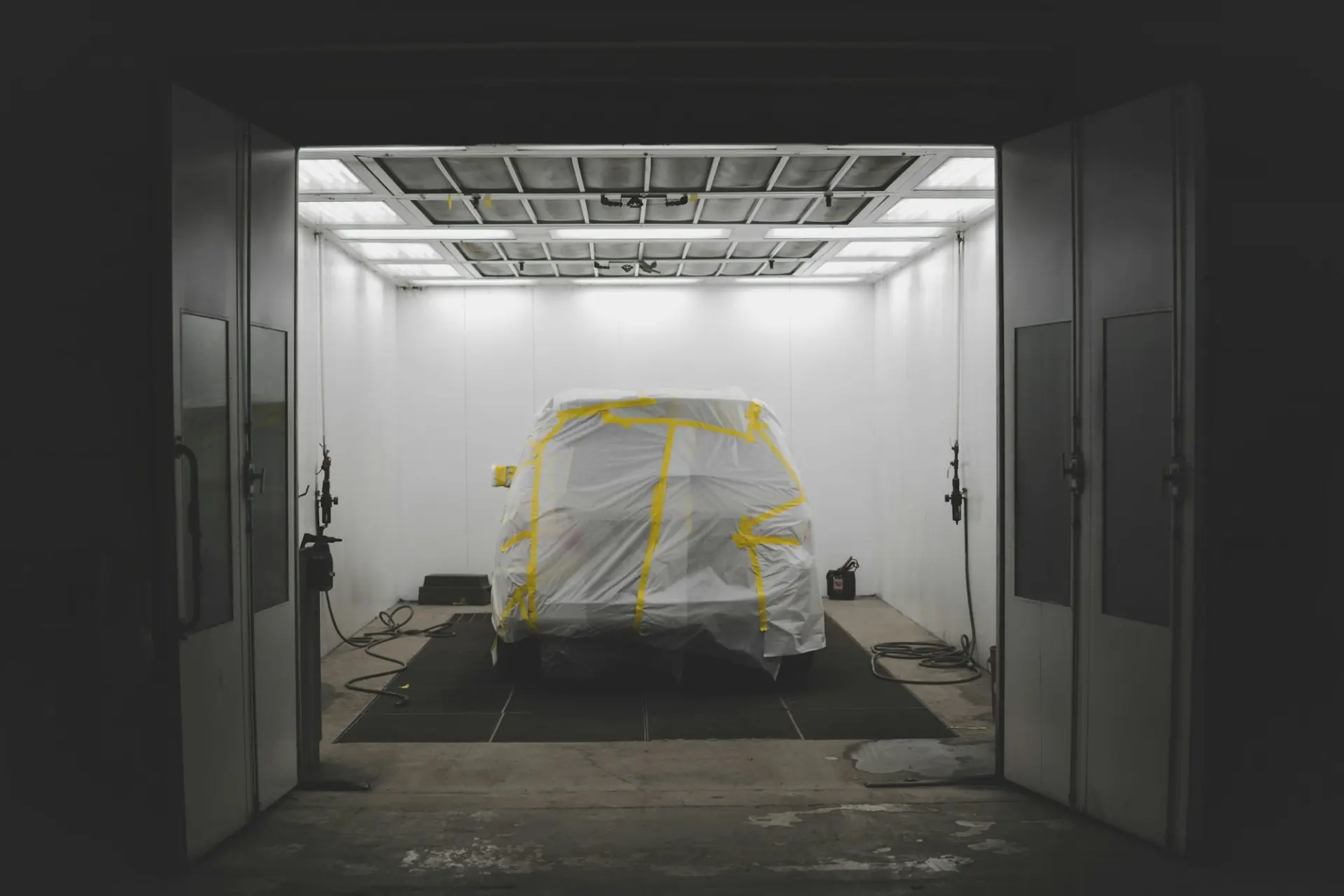
- Building and fire permits for the spray booth. Fire codes follow the NFPA 33 standard for spray booths, in whichever edition your city has adopted, and many require a yearly operating permit.
- Air permits. Some states and districts permit the booth too. Texas requires registration and a fee under its permit by rule 106.436 before construction, with monthly limits on paint and solvent use. Southern California's air district limits the solvent content of the paints you spray.
- Room to work: bays for each technician, the booth and mixing room, a frame area, parts storage, secure parking for customers' cars and a front office.
The EPA and OSHA rules
The EPA's auto body paint rule (40 CFR 63 subpart HHHHHH) covers all spray painting of motor vehicles, in a shop or as a mobile repairer. Spray guns with cups of 3 fluid ounces or less and aerosol cans are excluded.
- Painters must be trained and certified within 180 days of being hired, with refresher training every five years.
- Whole vehicles are painted in a fully enclosed booth or prep station, run at negative pressure, with filters that capture at least 98% of overspray. Spot repairs can use mobile enclosures.
- Spray guns must be HVLP, electrostatic, airless, air-assisted airless or an approved equivalent.
- Guns are cleaned without spraying solvent into the open air.
- File an initial notification within 180 days of opening (a new shop can certify compliance in the same notice), report changes by March 1 in any year they happen, and keep records for five years.
A shop that sprays no coatings containing chromium, lead, manganese, nickel or cadmium can file a notification of exemption instead. Hazardous waste rules apply to paint waste and solvents, by how much you produce a month: up to 100 kg makes you a very small quantity generator, and a small quantity generator (100 to 1,000 kg) needs an EPA ID number, a contingency plan and manifests. Most commercial uses of methylene chloride paint strippers are now banned.
OSHA
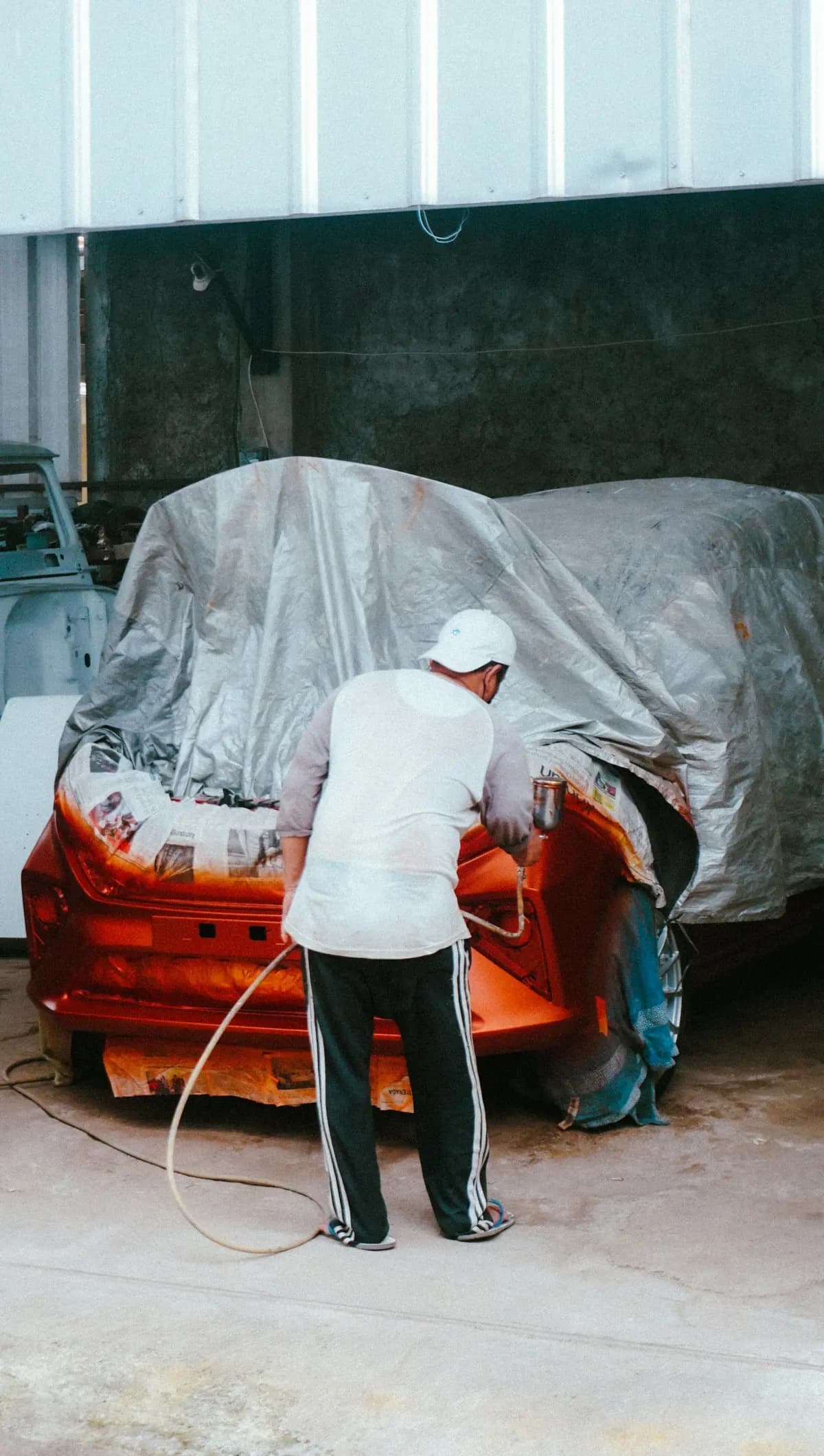
- Respirators: a written respirator program, a medical evaluation for each worker, fit tests before first use and every year, yearly training and a cartridge change schedule, all paid by you.
- Hazard communication: labels, safety data sheets and training. Under OSHA's updated rule, programs and training for single chemicals must be updated by November 20, 2026, and for mixtures by May 19, 2028.
- Spray finishing: a noncombustible booth with air moving at 100 feet a minute or more across its open face, no ignition sources within 20 feet unless partitioned off, rated electrical equipment, no more than a day's supply of paint nearby, sprinklers and No Smoking signs.
- Isocyanates in 2K paints and clears: OSHA's exposure ceilings are 0.02 ppm for MDI and TDI. Its welding rules cover fire watches and ventilation.
Insure the business
| Cover | What it does |
|---|---|
| Garage liability | Injury and damage to other people from your business. It doesn't cover customers' cars in your care |
| Garagekeepers | Customers' cars in your care. Legal liability pays only if you were negligent; direct primary pays whoever was at fault; direct excess pays after the customer's own insurance |
| Workers' compensation | Injuries to your staff. Required to license a shop in New York and New Jersey; in Texas most private employers can opt out but must report that they have |
| Property and equipment | The building's contents, the booth and your tools |
New Jersey's license requires at least $300,000 of garage liability and $50,000 of garagekeepers cover. We found no reliable published premiums, so get quotes.
Equip the shop
Equipment is the biggest cost after the building. Some list prices from October 2026:
| Equipment | List price |
|---|---|
| Semi-downdraft paint booth | $21,622 |
| Paint booth with heater | $56,475 |
| Scissor frame machine | $17,190 |
| Frame rack | $29,520 |
| Three-phase resistance spot welder | $15,950 to $28,900 |
| Double-pulse MIG welder that welds aluminum | $11,980 |
| 7.5 hp rotary screw compressor | $13,199 to $14,369 |
| Two-post lift, 9,000 lb | $2,940 to $3,050 |
| Mid-rise frame lift | $4,699 |
| ADAS calibration bay | $75,000 to $150,000 (estimates) |
| ALLDATA Collision repair information | $249 a month |
One equipment supplier's and one welder supplier's list prices on October 22, 2026, before installation, electrical work and permits. The calibration bay figure is a calibration vendor's and a business broker's estimate. CCC, Mitchell and Audatex don't publish prices.
Under Section 179, a business can deduct up to $2,560,000 of equipment bought in 2026 in the year it buys it, phasing out above $4,090,000 of purchases; ask your accountant how it applies to you. If you plan to seek automakers' certification later, price their required tools in from the start: our certifications guide lists what they ask for.
Hire your team
Body repairers' median pay
$26.89 an hour
In body, paint and glass shops, May 2025 (BLS).
Painters' median pay
$27.42 an hour
In the same shops, May 2025 (BLS).
Technician turnover
60.7%
Among collision technicians in 2025 (TechForce).
Technicians are the hardest part to find. New entrants fill only about four in ten of the collision technician jobs that open each year, according to TechForce Foundation's May 2026 report, and US collision schools produced 5,462 graduates in the 2023 to 2024 school year. The Bureau of Labor Statistics says new repairers need two to three years of training on the job to work on their own.
- Recruit from local collision programs, and offer apprenticeships: I-CAR runs a two-year registered apprenticeship approved by the Department of Labor.
- Get painters trained and certified under the EPA's rule within 180 days of hiring.
- Pay for ASE tests and I-CAR training: the collision tests are B2 to B5, and B6 for estimators.
- Choose a pay plan, hourly or flat rate, that meets federal and state wage law; our labor rate guide covers the rules.
Estimators earned a median $32.85 an hour in collision shops in May 2025. In New York, anyone who writes body estimates for a shop, owners included, needs an estimator's license from the DMV.
Finance the start
| Loan | What it covers | Key terms |
|---|---|---|
| SBA 7(a) | Equipment, working capital, real estate and buying a business | Up to $5 million, 75% guaranteed by the SBA. Up to 10 years for working capital or equipment, 25 for real estate. A business operating a year or less puts in at least 10% |
| 7(a) Small and SBA Express | The same, for smaller amounts | Up to $350,000 (85% guaranteed up to $150,000) and $500,000 (50% guaranteed) |
| SBA 504 | Real estate and equipment that lasts 10 years or more, not working capital | A bank lends up to 50% and a certified development company up to 40%. You put in at least 10%, or 15% as a new business |
From the SBA's lender rules (SOP 50 10 8.1, effective October 1, 2026). Variable interest on 7(a) loans is capped at the base rate plus 3% (over $350,000) to 6.5% ($50,000 or less), and guarantee fees run from 2% to 3.75% of the guaranteed part.
Keep enough cash to carry payroll and rent until money comes in. Insurers pay on their own timetable, and parts suppliers want paying on theirs.
Set your prices and paperwork
Set up your pricing and paperwork before the first car arrives:
- Your labor rates, worked out from what your technicians and building cost. Our labor rate guide works through an example.
- Estimates that meet your state's rules on written estimates and authorization: our estimate guide covers them.
- Parts and paint pricing, and how your state taxes parts and labor: see our parts and paint guide.
- A check-in sheet for every car, invoices that show sales tax and the deductible, and a record of every job.
Win your first work
- Tell drivers they can choose. Many states protect a customer's right to choose a repair shop; New York, for one, bars insurers from recommending a shop unless the customer asks. Say so on your website and your estimates.
- Build reviews from day one. In BrightLocal's 2026 survey, 97% of US consumers read reviews, 74% only count those from the last three months, and 47% avoid businesses with fewer than 20.
- Work with dealers, fleets and other shops that need body work done.
- Plan for insurance programs and certifications. Direct repair programs and automakers' networks usually want a track record, trained staff and the right equipment, so build toward them.
Your start-up checklist
- Decide the work you'll do and who you'll do it for.
- Form the business, get an EIN, and register for sales tax and as an employer.
- Find premises with the right zoning, and get building, fire and any air permits for the booth.
- License the shop with your state, where it requires one.
- Arrange garage liability, garagekeepers, workers' comp and property cover.
- Buy and install the booth and equipment; set up the mixing room and hazardous waste handling.
- File the EPA initial notification, train and certify painters, and set up your respirator program.
- Hire and train your team, and choose a pay plan that meets wage law.
- Set your labor rates, estimate and invoice formats, and check-in routine.
- Line up financing and enough cash to carry you until customers and insurers pay.